Composite molding
Release film for resin and carbon-fiber composite molding.
11 / SPECIALTY MATERIALS
For processes requiring low adhesion, chemical resistance or insulation. Select the grade, thickness and surface treatment around the actual process.
FEP is not inherently antistatic. Bonding may require a treated surface; performance depends on grade and operating conditions.
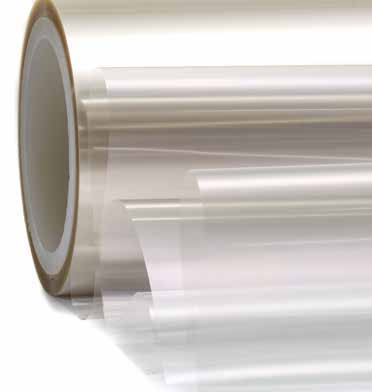
Select the grade and construction for the actual process. Specialized uses require separate qualification.
Release film for resin and carbon-fiber composite molding.
Insulation for flexible circuits, flat cables and wires.
Linings, diaphragms, gaskets, sample bags and containers.
Replaceable vat-bottom film for compatible machines. Service life depends on operating conditions.
Specialized FEP bag systems for culture, transfer or cryopreservation. Industrial film alone is not a qualified medical product.
Environmental growth chambers and solar collectors, subject to application evaluation.
Broader FEP applications include coatings and high-purity fluid systems. This does not qualify this film for wafer processing.
Reference values only. Final specifications depend on grade, thickness, test conditions and the agreed application.
| Property | Typical value | Test method / condition |
|---|---|---|
| Continuous service temperature | 205°C | — |
| Melting point | 252–282°C | ASTM D3418 |
| Specific gravity | 2.12–2.17 | ASTM D792 |
| Tensile strength | 24 MPa | ASTM D882 |
| Ultimate elongation | 300% | ASTM D882 |
| Water absorption | < 0.01% | 24 h |
| Dielectric strength | 240 kV/mm | ASTM D149 · 1 mil |
| Dielectric constant | 2.1 | ASTM D150 · 1 kHz |
Melting point is not the operating temperature. Contact Kuai Mond for material selection and application evaluation.